

Last Updated: October 25, 2026
Quick Summary
The best hygiene gear for off grid living is gear that works with no running water, no drain, and no trash pickup: large individually wrapped body wipes, soap or sanitizer, a trowel and pack-out bags, and sealed storage. Build the kit around four jobs: body cleaning, hand hygiene, waste, and gear care.
- Manshowr XL Cooling Body Wipes are 23 x 16 in, about 6x the area of a standard 7 x 8 in baby wipe.
- One wipe usually handles a full upper-body cleanup, and heavy sweat may take two.
- Dig catholes 6 to 8 inches deep, well away from water, trails, and camp, and pack out paper and wipes.
- A box of 12 wipes lasts about 12 days at one a day or about 6 days at two a day.
- One box of Manshowr XL Cooling Body Wipes is $29.95, and bundles are available.
Table of Contents
- Camping Hygiene Essentials: Start With What You Actually Need
- Body Wipes for Camping: What Separates a Real Wipe From a Fancy Napkin
- How to Stay Clean While Camping Without a Shower
- Hygiene Products for Dispersed Camping: Water, Waste, and What to Leave Home
- Planning Your Kit Around Water Availability
- Storage, Shelf Life, and Keeping Gear Ready Between Trips
- Choosing Your Off Grid Hygiene Kit Before the Next Trip
- Frequently Asked Questions
Camping Hygiene Essentials: Start With What You Actually Need
The best hygiene gear for off grid living is the gear that still works when there is no running water, no drain, and no trash pickup for miles.
This guide from Manshowr breaks the kit down by job instead of product category, because that is how you actually pack. For a deeper look at body wipes made specifically for camping, see Best Body Wipes For Camping.
The Four Jobs Every Off Grid Kit Has to Handle
Every off grid hygiene kit answers four questions: how do I clean my body, how do I clean my hands, how do I manage waste, and how do I keep my gear from turning into a science project between trips. Gear that does not map to one of those jobs is weight you will resent by day two.
- Body cleaning: wipes, a small towel, and a way to wipe down without soaking your whole camp.
- Hand hygiene: soap or sanitizer, plus water discipline. The CDC handwashing guidance is blunt about soap and water being the first choice and sanitizer being the backup when hands are not visibly dirty.
- Waste: toilet paper, a trowel, and a plan for packing out what does not belong in the ground.
- Gear care: sealed storage and a dry-out plan so towels, soap, and wipes are ready for the next trip.
Get those four right and the rest is preference. Get them wrong and you are the guy who brought a full shampoo bottle and no way to deal with trash.
Body Wipes for Camping: What Separates a Real Wipe From a Fancy Napkin
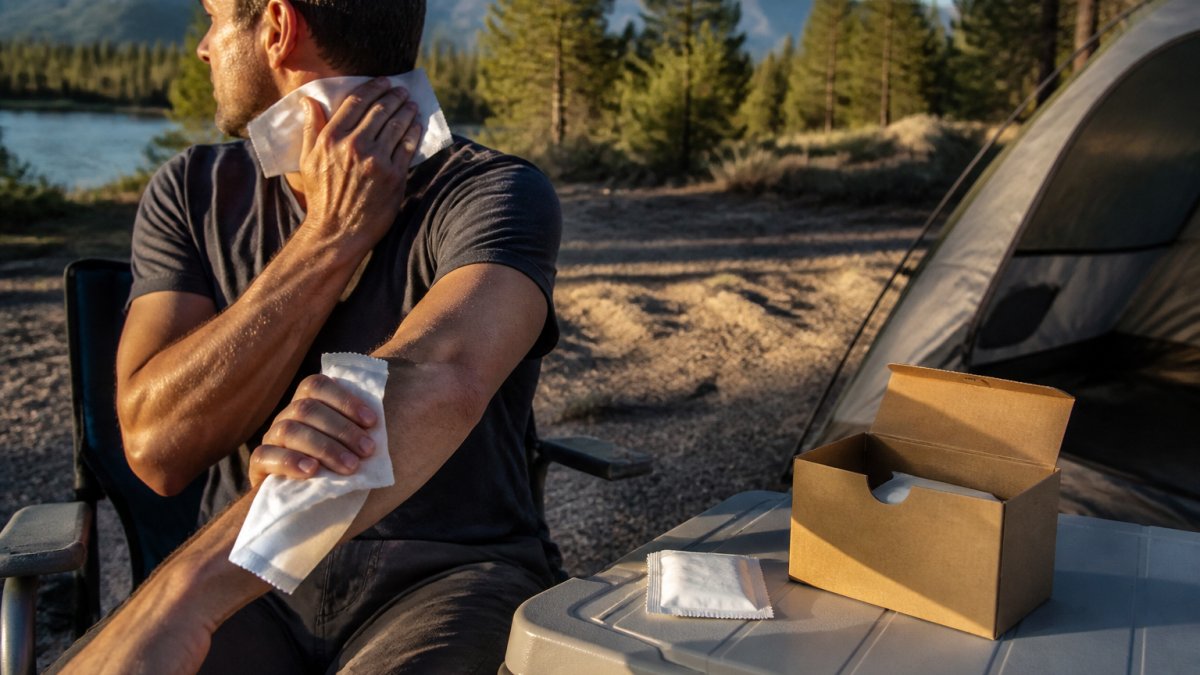
The difference between a body wipe that works and a fancy napkin comes down to three things: surface area, moisture retention, and cloth strength. Too small forces you to use three. Dried out in the sachet is useless when you need it. Shredding mid-pass leaves lint on your skin and a mess in your hand.
Standard baby wipes run about 7 x 8 in. That is fine for a diaper and bad for a grown adult who has been hiking in the sun all day.
Size, Sachet, and Cloth: The Three Specs That Matter
Size is the spec that saves you money. One wipe usually handles a full upper-body cleanup, and heavy sweat may take two.
The sachet matters more than people think. Individually wrapped wipes do not dry out, do not leak into your pack, and do not force you to open a whole stack to get one.
Cloth is the third leg. Viscose holds up to a real pass across a sweaty back. The cloth is viscose fiber, certified biodegradable in soil by TÜV AUSTRIA Belgium.
How to Stay Clean While Camping Without a Shower
Staying clean without a shower is a routine problem, not a product problem.
Here is the routine:
- Start at the neck and work down. Neck, shoulders, chest, arms, then underarms. That is where sweat and campfire smoke collect first.
- Do the back with a second wipe if you can reach it. A long wipe helps here. This is where the 23 x 16 in size earns its keep.
- Hit the feet last. Separate wipe, and keep it separate.
- Dry off with a quick-drying towel if you used a wet wipe and the air is cool.
- Change into clean base layers. Clean clothes do more for how you feel than a second pass with a wipe.
Keep them off your face and away from your eyes. Use them from the neck down. If you have sensitive skin, patch test on your inner forearm first.
Watch out: the biggest mistake is wiping down and then putting the same sweaty shirt back on. You will smell the same in an hour.
Hygiene Products for Dispersed Camping: Water, Waste, and What to Leave Home
Dispersed camping changes the gear list because there is no spigot, no dumpster, and no camp host. The US Forest Service dispersed camping guidance is clear that these sites have no amenities, so everything you need comes in with you and goes out with you.
Leave home: anything that needs rinsing, anything in glass, and anything that assumes a drain. Bring: a small trowel, toilet paper in a sealed bag, hand sanitizer, biodegradable soap for dishes, and a trash bag that actually closes.
Wastewater: The Part Most Guides Skip
Greywater is the dirty water left after dishes, hand washing, or a rinse-down. It is not harmless, and it is not something you dump in a pile behind the tent. Strain out food particles, then scatter the water widely, well away from camp, trails, and any water source. Food particles go in your trash bag, not on the ground. Never pour greywater into a stream or lake.
Human Waste: Catholes, Pack-Out, and Longer Stays
A cathole is the standard method where it is allowed: dig 6 to 8 inches deep, well away from water, trails, and camp, use it, cover it, and pack out your paper and wipes. The Leave No Trace guidance is a useful reference for the distance and depth rules, and local land managers may have stricter ones.
Catholes stop working for longer stays and larger groups. That is when you move to a pack-out system: a rigid container with a secure lid, or a wag bag style system that seals waste for carry-out.
Wipes do not go in a cathole. Used wipes go in the trash, never the toilet. Outdoors, pack them out. That rule holds whether you are on a one-night trip or a two-week stay.
Manshowr XL Cooling Body Wipes (23inx16in) - The Field Mix - 3 Box Variety →
What to Leave Home
Anything that needs a drain, a rinse you cannot afford, or assumes trash pickup. That includes most liquid body washes, anything in glass, and any product that only works with running water. The kit that survives dispersed camping is the one that works when nothing else does.
Planning Your Kit Around Water Availability
Water availability should drive the whole kit, not the other way around. Most off grid hygiene advice treats water as an afterthought and then hands you a list of products that all assume a rinse.
A common planning figure for backcountry trips is about one gallon per person per day for drinking and cooking, with cleaning water on top. Treat that as a starting point, not a rule. Hot weather, altitude, and hard work push drinking needs up, and the cleaning budget is whatever is left. Three scenarios cover most trips:
| Water scenario | Body cleaning | Hand cleaning | Waste plan |
|---|---|---|---|
| Plenty of water at camp | Body wipes plus a rinse cloth | Soap and water | Standard cathole where allowed, pack out paper and wipes |
| Limited water, roughly 1 to 2 gallons per person per day | Body wipes only | Soap for hands, sanitizer as backup | Pack out all paper and wipes |
| No water source, carry everything | Body wipes only | Sanitizer only | Pack out everything, no burial |
The middle row is where most people live. When water is tight, body wipes do the cleaning work and you save the water for drinking and cooking.
How Each Scenario Changes the Routine
Plenty of water. You can afford a rinse cloth and a real soap-and-water hand wash. The gear list grows: a small collapsible basin, a quick-drying towel, and a way to manage the greywater you generate.
Limited water. Every ounce gets counted. The CDC handwashing guidance is clear that soap and water is the first choice and sanitizer is the fallback.
No water source. You are carrying everything in and everything out.
The Gear Trade-Off Nobody Talks About
Every water scenario forces a trade between weight, water use, and days before restocking. A rinse cloth is reusable but needs water and a dry-out plan. A body wipe is single-use but needs no water and no drying.
A box of Manshowr XL Cooling Body Wipes is 12 individually wrapped wipes. At one a day that is about 12 days, and at two a day it is about 6 days.
Storage, Shelf Life, and Keeping Gear Ready Between Trips
Storage is where good kits quietly fall apart. For practical tips, read How To Keep Wipes From Drying Out.
Individually wrapped wipes solve most of this. Each wipe is sealed in its own sachet, so it stays moist until you open it.
Watch out: packing a damp towel next to dry gear is how you get mildew in a bag you will not open for a month.
Choosing Your Off Grid Hygiene Kit Before the Next Trip
Build the kit in four passes and you will not overpack. Body cleaning first, hand hygiene second, waste third, storage last. Everything else is a nice-to-have.
For body cleaning, Manshowr XL Cooling Body Wipes come in three scents: Limitless Eucalyptus, Citrus Punch, and Fragrance Freedom, which has no added fragrance and is a good starting point for sensitive skin. One box is $29.95. If you want to try all three before committing, the Manshowr XL Cooling Body Wipes (23inx16in) - The Field Mix - 3 Box Variety Bundle (36 Wipes) is available. Keep them off your face and away from your eyes, and patch test on your inner forearm if your skin runs sensitive.

The best hygiene gear for off grid living is not the biggest kit. It is the one you will actually restock, carry, and use at the end of a long day when you are tired and the last thing you want is a project.
Frequently Asked Questions
What hygiene gear should you pack for an off grid trip?
Build the kit by task, not by brand. You need something for body cleaning, something for hands, something for dishes and laundry, and a plan for human waste. Body wipes cover the body job, a small bottle of hand sanitizer covers hands between washes, a biodegradable soap handles dishes and clothes, and a trowel plus a way to pack out used paper covers the rest. Add a quick-drying towel and you have a kit that handles a week without running water.
How do you stay clean while camping without a shower?
Work in order from cleanest to dirtiest. Wipe down your neck, chest, arms, and back first, then legs and feet, then anything else. One oversized body wipe usually handles a full upper-body cleanup, and heavy sweat may take two. Keep wipes off your face and away from your eyes, and use them from the neck down. A daily wipe-down plus clean socks and a fresh shirt does more for how you feel than a full wash on day four.
Are body wipes for camping worth the space they take up?
They earn their spot when water is limited or the weather is cold enough that a full wash is not happening. The specs to check are cloth size, individual sachets, and what the cloth is made of. Manshowr XL Cooling Body Wipes are 23 x 16 in, about six times the area of a standard 7 x 8 in baby wipe, and each one is sealed in its own sachet so it stays moist until you open it. A box of 12 runs $29.95 and lasts about 12 days at one a day.
How do you handle waste and used wipes at a dispersed campsite?
Used wipes go in the trash, never the toilet, and outdoors you pack them out with you. Bring a sealable bag dedicated to that job and keep it separate from food. For human waste, follow the land manager's rules for the area you are in, which usually means a cathole dug with a small shovel well away from water, trails, and camp, or a portable toilet system where catholes are not allowed. Check the specific rules for your site before you go.
How should you store hygiene gear between trips?
Keep it dry, keep it together, and keep it where you will actually grab it. A single bin or stuff sack per task means you are not rebuilding the kit every trip. Individually sealed sachets hold up well in a truck cab or a pack because each wipe stays sealed until you open it. Check your kit before every trip, replace anything you used on the last one, and store soap and towels dry so nothing grows in the bag between outings.
Building a kit that works past day three takes gear you trust and a routine you will actually follow. Manshowr XL Cooling Body Wipes are 23 x 16 in, individually sealed in sachets, and made to wipe off sweat and grime so you feel fresher until your next shower. Start with a single box of Manshowr XL Cooling Body Wipes (23inx16in) - Limitless Eucalyptus - 1 Box and see how it fits your pack.


0 comments