

Table of Contents
- What Construction Workers Actually Need From Heavy Duty Wipes
- Quick Comparison: Manshowr XL Wipes by Pack Size and Price
- Industrial Hand Wipes vs. Heavy-Duty Hand Cleaning Wipes
- Textured Cleaning Wipes: Why Fabric Type Decides the Job
- Construction Worker Body Wipes for End-of-Shift Cleanup
- How to Choose Heavy Duty Wipes for Jobsite Conditions
- Cost, Disposal, and Buying Quantities for a Crew
- Frequently Asked Questions
Last Updated: October 9, 2026
What Construction Workers Actually Need From Heavy Duty Wipes
Heavy duty wipes for construction workers solve one problem: getting industrial grime off skin, tools, and surfaces when there's no sink, no soap, and no time.
That gap is where Manshowr operates.
The math on why this category exists: a worker on a 10-hour pour finishes coated in concrete dust, sweat, and hydraulic oil residue.
Below: what separates a wipe that survives a jobsite from one that shreds in your hand, plus pack-size comparison, crew cost math, and selection criteria.
Quick Comparison: Manshowr XL Wipes by Pack Size and Price
Manshowr sells in three tiers: single boxes for testing, bundles for regular users, and master cases for crews and resellers.
| Option | Wipes Included | Price | Best For |
|---|---|---|---|
| Single Box, Limitless Eucalyptus | 12 | $31.95 | First-time buyers, glovebox backup |
| 2-Box Bundle, Citrus and Eucalyptus | 24 | $49.95 | Solo tradesman, one month of shifts |
| 3-Box Field Mix | 36 | $69.95 | Testing all three scents |
| Wholesale Master Case | 96 | $150.00 | Crews, shops, resale |
Bundles pull the cost down and the master case drops it further, which is why crews buy by the case.


One note on scent: Fragrance Freedom exists for guys who work around clients or in shared cabs where a eucalyptus blast is not welcome. The Eucalyptus and Fragrance Freedom bundle covers both moods.
Industrial Hand Wipes vs. Heavy-Duty Hand Cleaning Wipes
Industrial hand wipes and heavy-duty hand cleaning wipes are not the same product, and mixing them up wastes money. Industrial hand wipes are pre-moistened towels with a citrus or pumice-based cleaner for grease, oil, and ink.
The distinction shows up in three places:
- Solution chemistry. Grease-cutting formulas use citrus solvents or alcohol blends. Body-safe formulas use water, glycerin, aloe, and essential oils.
- Fabric construction. Industrial towels are usually spunlace or meltblown. Body wipes are typically viscose or bamboo-based.
- Regulatory framing. Industrial hand cleaners fall under OSHA's hand protection and hygiene guidance for workplace skin exposure, which is why employers stock them near wash stations.
The practical call: keep an industrial hand wipe in the toolbox for grease and paint, and a heavy duty body wipe in the cab for skin.
Textured Cleaning Wipes: Why Fabric Type Decides the Job
Textured cleaning wipes outperform smooth ones on any surface with grit, grooves, or residue. The texture grabs particles a flat sheet just smears around.
Fabric type does most of the work.
Dual-texture wipes combine a smooth side for wiping with a rougher side for scrubbing.
What most guides miss: sheet size matters as much as texture. A 6-inch wipe forces folding and refolding, which pushes grime back onto your hands.
Matching texture to the mess
Not every jobsite residue behaves the same way. A quick field guide:
- Concrete and mortar dust. Fine, alkaline, and it gets into every crease. A textured side lifts it; a smooth sheet just pushes it around and leaves a chalky film. Wipe once, fold, wipe again. Do not scrub hard, because you are grinding silica into your skin.
- Dried joint compound. Essentially chalky plaster. It powders when you rub it and turns to paste when wet. A lightly damp textured wipe breaks the surface; a soaked one makes mud. Use the rough side first, then flip.
- Caulk and silicone sealant. Fresh beads wipe off with a textured sheet. Cured silicone does not come off with any wipe, and trying is how you tear the fabric. Scrape first, wipe second.
- Construction adhesive and contact cement. Solvent territory. A water-based body wipe will smear them into a bigger stain. Keep a solvent hand wipe for this and save the body wipe for skin.
- Paint, primer, and stain. Water-based latex comes off hands with a textured wipe if you catch it before it cures. Oil-based paint and stain need solvent. Once either dries, you are looking at a pumice hand cleaner, not a wipe.
- Grease, hydraulic oil, and diesel film. The classic heavy duty target. A textured wipe with a citrus or surfactant formula lifts most of it in two passes. A second wipe and a dry rag finish off the film.
- Sweat, sunscreen, and bug spray. The end-of-shift layer. This is where an oversized body wipe earns its keep, covering neck, arms, and pits in one sheet rather than three.
What to look for on the label
Fabric weight is listed in grams per square meter, or GSM. Under 40 GSM and the wipe is a paper towel in disguise. Most heavy duty wipes land between 50 and 80 GSM.
If a wipe shreds when you wring it out, it will shred on your hands. That is the simplest field test there is, and it takes five seconds at the truck tailgate.
Construction Worker Body Wipes for End-of-Shift Cleanup
Construction worker body wipes are the end-of-shift answer when the site has no shower and the commute is an hour.
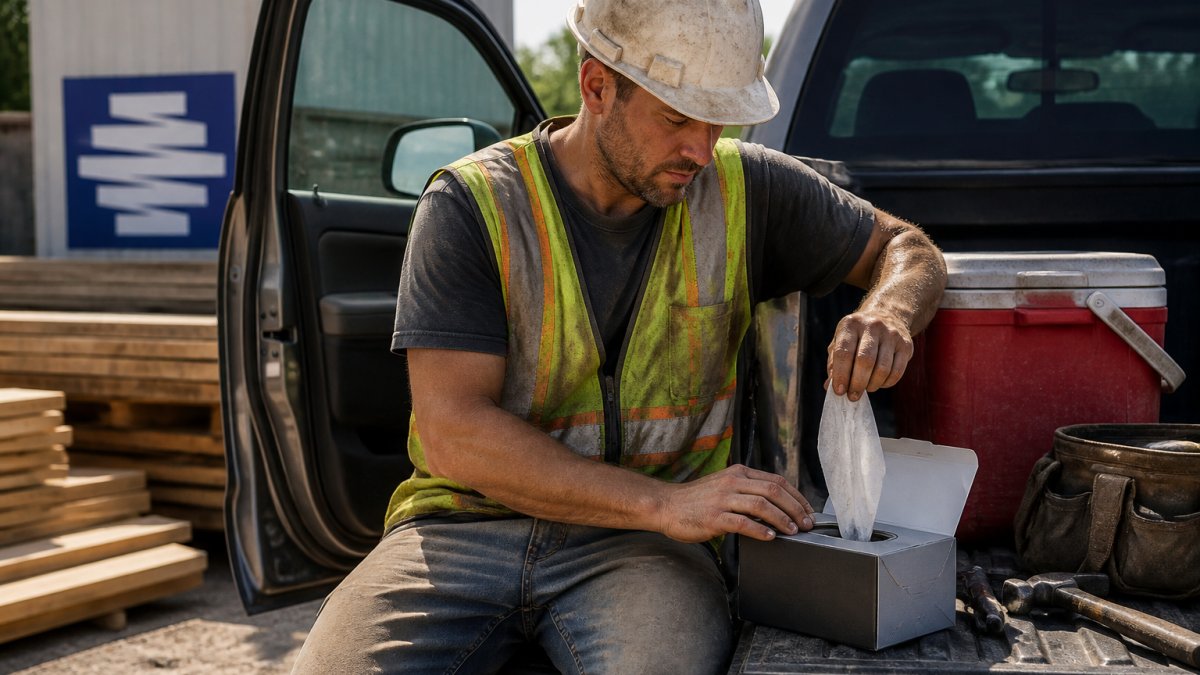
The scenario plays out the same way on most sites. You finish at 5:30, covered in dust and sweat, with a 45-minute drive before a shower.
Manshowr's XL wipes are sized for this moment. The Eucalyptus 3-Box Bundle is the version most guys start with.
Wholesale Master Case - Manshowr XL Cooling Body Wipes (23inx16in) - Limitless →

What a body wipe is not
A body wipe is not a shower, and treating it like one is how guys end up with rashes and clogged drains.
It does not replace handwashing. If you have been handling treated lumber, wet concrete, or anything with a safety data sheet, a wipe is a stopgap, not a substitute.
It does not replace PPE. Gloves, sleeves, and eye protection do the heavy lifting on skin exposure. A wipe cleans up after the fact.
Ingredient transparency and skin safety
Anything you rub on your face, neck, and pits after a 10-hour shift deserves a label check. What to look for:
- Alcohol content. Alcohol-based wipes dry out skin fast, and repeated use in cold weather leads to cracking. Body wipes for daily use should be alcohol-free.
- Fragrance. Some guys work around clients, in shared cabs, or next to someone who reacts to strong scents. Fragrance-free options exist for that reason. Manshowr's Fragrance Freedom line is the version to grab if eucalyptus in a crew cab is going to start a conversation.
- Preservatives and surfactants. These keep a wet wipe from growing mold in the package. Most people are fine with them. If you have known sensitivities, patch test on your forearm before you commit to a full wipe on your face.
- What is actually in it. Manshowr publishes their ingredient list: water, glycerin, aloe, eucalyptus oil, and vitamin E. No alcohol, no harsh solvents. The FDA guidance on cosmetic labeling explains why ingredient transparency matters for anything applied to skin.
If a wipe stings, stop using it. That is not a sign it is working. It is a sign your skin is telling you something.
Disposal on a jobsite
Even biodegradable wipes should not go in a toilet. They clog plumbing. Manshowr's viscose fabric breaks down in soil, not in water, so the trash bin is the correct destination.
Used wipes that have picked up paint, solvent, or hydraulic oil are not just dirty rags. Keep them in a closed container until you can dispose of them properly, and follow EPA guidance on solid waste disposal for general waste handling on commercial sites.
How to Choose Heavy Duty Wipes for Jobsite Conditions
1. Fabric weight and construction. Spunlace or heavy viscose holds up to scrubbing. Cheap non-woven falls apart.
2. Solution type. Match the cleaner to the grime. Citrus or solvent blends for grease and paint.
3. Sheet size. Anything under 10 inches forces folding. Oversized sheets like Manshowr's format cover more surface with fewer passes.
4. Packaging and shelf life. Individually wrapped sachets stay moist. Resealable bulk packs dry out once opened.
For skin safety, check the ingredient list. The FDA guidance on cosmetic labeling explains why ingredient transparency matters for anything applied to skin.
Cost, Disposal, and Buying Quantities for a Crew
Cost per wipe drops fast as pack size grows, and the gap between single boxes and master cases is where crews save real money.
Here is the crew math. A five-person crew using one wipe per person per shift burns 25 wipes a week, or about 100 per month.
| Crew Size | Wipes per Month | Recommended Order | Approximate Cost |
|---|---|---|---|
| 1 worker | 20 | 2-Box Bundle | $49.95 |
| 3 workers | 60 | 3-Box Field Mix x2 | $139.90 |
| 5 workers | 100 | 1 Master Case | $150.00 |
| 10 workers | 200 | 2 Master Cases | $300.00 |
For environmental compliance, follow EPA guidance on solid waste disposal for general waste handling on commercial sites.
Frequently Asked Questions
Can heavy duty wipes remove grease, paint, and construction grime?
The fabric does most of the work. A textured, pre-moistened wipe with a spunlace or viscose cloth lifts grease, oil, dust, and uncured paint off skin and hard surfaces better than a smooth wipe because the texture traps particles instead of smearing them. For cured paint, adhesive, or ink, expect the wipe to soften and lift the top layer rather than dissolve it completely. Wipe size matters too: an oversized wipe covers more surface per sheet, so you use fewer wipes per cleanup.
What should construction workers look for in heavy duty wipes?
Four things: fabric weight, texture, moisture retention, and pack format. Look for a cloth that will not shred when you scrub a wrench or a forearm covered in oil. Dual-texture or textured cleaning wipes give you a scrubbing side. Individually wrapped sachets stay wet in a truck cab or gang box for weeks, while a bulk tub dries out once the seal breaks. Finally, check the ingredient list. A short list (water, glycerin, aloe, vitamin E) is easier on skin than a long one full of solvents.
Are hand-cleaning wipes the same as disinfecting wipes?
No. Hand-cleaning wipes are formulated to remove dirt, grease, and sweat from skin. Disinfecting wipes are formulated to kill pathogens on hard, non-porous surfaces and often carry harsh chemicals that should not sit on your skin. Using a disinfecting wipe on your hands can dry them out or cause irritation. Keep both on the truck if you want them, but do not swap one for the other. Read the label to confirm what a wipe is actually cleared for.
How should used industrial wipes be disposed of on a job site?
Trash bin, never the toilet. Even wipes made from biodegradable plant-based viscose will clog plumbing because they do not break down fast enough in water. On a job site, that means a sealed trash can or a dedicated waste bag in the gang box. If a wipe has picked up solvent, paint thinner, or another regulated substance, follow your site's hazardous waste procedure instead of tossing it in general refuse. Check with your site supervisor for local rules.
Can construction workers use body wipes to freshen up after a shift?
Yes, and it is the most common use. A full-body wipe takes about 60 seconds and removes sweat, dust, and grime before you get in the truck or walk into a store. Manshowr XL wipes are built for full-body coverage in one sheet, with a cooling eucalyptus and menthol finish. They are not a substitute for a real shower, but they bridge the gap between the end of a shift and the next one.
The real challenge isn't finding a wipe. It's finding one that survives a 12-hour shift without shredding, stays moist in a hot truck, and doesn't leave your skin cracked and raw. Manshowr builds for exactly that: 15.7-inch by 23.6-inch oversized sheets, a eucalyptus and menthol cooling formula, individually wrapped sachets that hold up in a glovebox, and a wholesale master case for crews that buy by the month. Add a box to the truck and stop dreading the drive home.
0 comments