

Table of Contents
- Why Eucalyptus Wipes Can Irritate Sensitive Skin
- Ingredients to Avoid in Body Wipes for Sensitive Skin
- How to Test Body Wipes for Skin Reaction Before Full Use
- Can You Use Body Wipes on Your Face?
- Who Should Skip Eucalyptus Wipes Entirely
- Sensitive-Skin Alternatives That Still Get You Clean
- What to Do When Eucalyptus Wipes Are Your Only Option
- Frequently Asked Questions
Last Updated: September 30, 2026
Why Eucalyptus Wipes Can Irritate Sensitive Skin
Eucalyptus wipes can irritate sensitive skin because eucalyptus oil contains compounds that trigger a reaction in some people. The two main culprits are eucalyptol and limonene. Both are volatile organic compounds that give eucalyptus its sharp, clean scent. They also happen to be common skin sensitizers.
Here's the catch. A wipe that says "eucalyptus" on the label might contain eucalyptus oil, eucalyptus extract, or just synthetic eucalyptol. Each one behaves differently on skin.
American Contact Dermatitis Society allergen information
The reaction usually shows up as redness, stinging, or small bumps within minutes to hours of use. For most guys, it fades fast. For others, it's the start of a longer problem.
The Difference Between Irritation and Allergic Contact Dermatitis
Irritation and allergic contact dermatitis are not the same thing, and the difference matters for how you handle it.
Irritation is a direct chemical burn. It happens the first time you use a product and it hits everyone at a high enough dose. It stays where you wiped.
Allergic contact dermatitis is an immune response. It can take several exposures to develop. Once it starts, it can spread beyond the area you wiped and get worse with each use.
A common mistake is assuming a mild first reaction means the product is safe. With allergic contact dermatitis, the first few uses often feel fine. The reaction builds.
How Concentration Thresholds Change the Risk
Concentration is the biggest factor most people ignore. A wipe with a trace of eucalyptus extract is a different product than one soaked in eucalyptus oil.
Fragrance ingredients like eucalyptol and limonene have known sensitization thresholds. Below a certain concentration, most people won't react. Above it, the risk climbs fast. The problem is that most wipe labels don't list percentages.
What most guides miss is that "natural" eucalyptus oil is often more irritating than a lab-made version. Natural oils carry variable concentrations of sensitizers. A synthetic version can be standardized to a lower, safer level.
Ingredients to Avoid in Body Wipes for Sensitive Skin
The ingredients to avoid in body wipes for sensitive skin fall into three groups: fragrance, preservatives, and harsh surfactants. Fragrance is the number one cause of cosmetic contact reactions.
Watch for these on the label:
- Fragrance and parfum - catch-all terms that can hide dozens of sensitizers
- Eucalyptus oil and eucalyptol - the compounds behind most eucalyptus reactions
- Limonene and linalool - citrus and floral scent compounds that oxidize into irritants
- Methylisothiazolinone (MI) - a preservative linked to rising allergy rates
- Alcohol denat - strips the skin barrier and amplifies other irritants
- Sodium lauryl sulfate (SLS) - a strong surfactant that disrupts skin barrier function
FDA information on cosmetic ingredients and labeling
Fragrance sensitivity is common. Even products labeled "unscented" can contain masking fragrances. Look for "fragrance-free" instead, which means no scent compounds were added at all.
How Eucalyptus Interacts With Other Ingredients
Eucalyptus doesn't act alone. It interacts with whatever else is in the wipe, and those interactions change the risk.
Alcohol plus eucalyptus is a bad combo. Alcohol opens the skin barrier, which lets eucalyptus compounds penetrate deeper. Menthol does something similar. It creates a cooling sensation while also increasing how much other stuff gets through.
Manshowr XL - Cooling Body Wipes →
Preservative systems matter too. Some preservatives are mild on their own but react with fragrance compounds to create new irritants. This is one reason two wipes with identical eucalyptus levels can behave very differently.
How to Test Body Wipes for Skin Reaction Before Full Use
Patch testing is the only reliable way to know how your skin reacts before you wipe down your whole body. It takes two days and costs you nothing but patience.
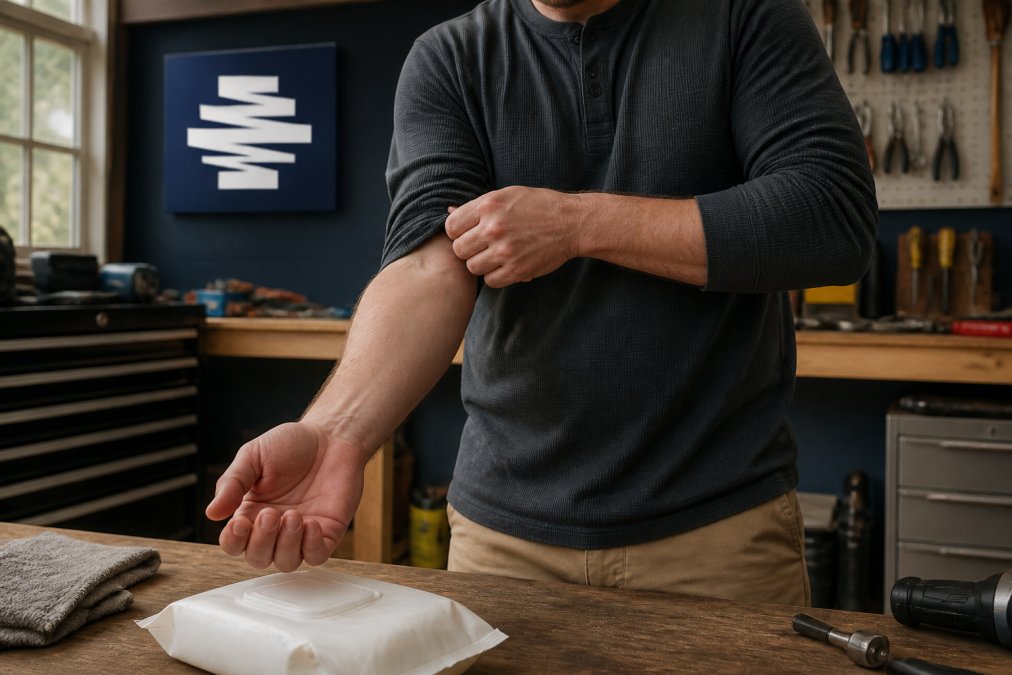
Here's the protocol:
Step-by-Step Patch Testing Protocol
- Pick the right spot. Use the inside of your forearm or the side of your neck. Thin skin there reacts faster than your back or legs.
- Clean the area first. No lotion, no cologne, no sunscreen. Bare skin only.
- Wipe a small patch. About the size of a quarter. Use the actual wipe, not a diluted version.
- Leave it alone for 24 hours. Don't wash it. Don't cover it. Let it sit.
- Check at 24 hours. Look for redness, bumps, itching, or stinging.
- Check again at 48 hours. Delayed reactions often show up on day two.
- Wait 72 hours before full use. If nothing shows up by then, you're likely clear.
If you see any reaction, stop. Don't try a "smaller amount" to build tolerance. That's not how sensitization works.
Can You Use Body Wipes on Your Face?
You can use body wipes on your face, but most aren't built for it. Facial skin is thinner and more permeable than the skin on your back or arms. The same wipe that feels fine on your chest can sting your cheeks.
If you're going to use a body wipe on your face, check three things first:
- No alcohol denat - it dries out facial skin fast
- No strong fragrance - facial skin reacts more to scent compounds
- No exfoliating acids - glycolic or salicylic acid in a body wipe is too harsh for daily facial use
The pH balance matters here too. Facial skin sits at a slightly acidic pH.
Who Should Skip Eucalyptus Wipes Entirely
Some people should skip eucalyptus wipes and not think twice about it. If you fall into any of these groups, the risk isn't worth the convenience.
- Anyone with atopic dermatitis or eczema - a compromised skin barrier lets irritants in faster
- People with a known fragrance allergy - eucalyptus is a common cross-reactor
- Anyone with rosacea or sensitive facial skin - the cooling compounds can trigger flushing
- Parents using wipes on infants - pediatric skin is far more permeable than adult skin
- People with a history of contact dermatitis - once sensitized, reactions tend to get worse
National Eczema Association guidance on irritants
Sensitive-Skin Alternatives That Still Get You Clean
Sensitive-skin alternatives still get you clean without the eucalyptus risk. The trick is swapping the scent compounds for gentler ingredients that do the same job.
Here's how the main options stack up:
| Option | Key Difference | Best For | Watch Out For |
|---|---|---|---|
| Fragrance-free wipes | No added scent compounds | Reactive or allergy-prone skin | "Unscented" can still hide masking fragrance |
| Menthol-only wipes | Cooling without eucalyptus | Guys who want the chill | Menthol can still sting broken skin |
| Plain water wipes | Minimal ingredient list | Very sensitive skin | Less cleaning power on heavy sweat |
| Micellar wipes | Gentle surfactants | Facial and body use | Check for alcohol content |
| Hypoallergenic wipes | Formulated to reduce reaction risk | Daily use on sensitive skin | "Hypoallergenic" isn't a regulated term |
What to Do When Eucalyptus Wipes Are Your Only Option
Sometimes eucalyptus wipes are all you've got. You're in a truck cab, a gym locker room, or a campsite, and it's that or nothing.
Here's how to use them with less risk:
- Wipe the tough areas first. Chest, back, pits. Save your face and neck for last, if at all.
- Don't scrub. Light passes are enough. Friction opens the skin barrier.
- Rinse if you can. A splash of water after wiping removes leftover residue.
- Follow with a barrier cream. It helps seal the skin back up.
- Don't use them daily. Rotate with a fragrance-free option when you can.
Frequently Asked Questions
Can essential oils like eucalyptus cause contact dermatitis?
Yes. Eucalyptus oil contains compounds like eucalyptol that can trigger allergic contact dermatitis in some people, especially those with existing skin sensitivity or atopic dermatitis. Fragrance sensitivity is one of the most common reasons people react to scented wipes. If you have a history of skin reactions to botanical extracts or fragrances, patch test any eucalyptus wipe on a small area before using it on your full body.
Which wipes are good for sensitive skin?
Unscented, fragrance-free wipes are your safest bet. Look for products that skip essential oils, alcohol, and harsh preservatives like methylisothiazolinone. Formulas with minimal ingredients and a pH balance close to skin's natural range tend to cause fewer reactions. If you still want the cooling effect of eucalyptus wipes, patch test first on your inner forearm and wait 48 hours. Some brands offer fragrance-free versions of their standard wipes, which gives you the same oversized cleaning power without the botanical extracts that trigger sensitivity.
How can I tell if a body wipe will irritate my skin?
Read the ingredient list before buying. Red flags include essential oils, synthetic fragrance, alcohol denat, and preservatives like methylisothiazolinone or formaldehyde releasers. Then patch test: wipe a small area on your inner forearm, wait 48 hours, and check for redness, itching, or bumps. If nothing happens, try a larger area like your chest or upper arm.
Are unscented wipes better for sensitive skin?
In most cases, yes. Unscented and fragrance-free wipes remove one of the biggest triggers of skin sensitization. Fragrance mixes are among the top causes of allergic contact dermatitis from personal care products. That said, unscented does not automatically mean hypoallergenic. Some fragrance-free wipes still contain preservatives or surfactants that can irritate sensitive skin. Check the full ingredient list, not just the front label. If you want zero fragrance risk, a fragrance-free wipe is your best starting point before trying anything with eucalyptus or other botanical extracts.
0 comments